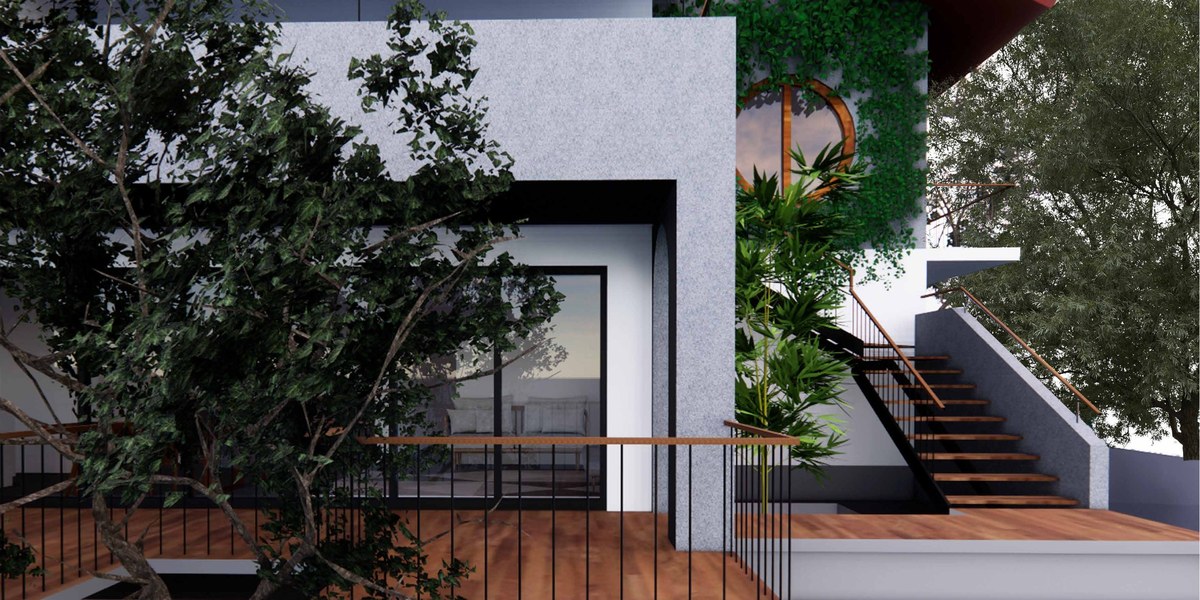
The client brief for the House on the Hills in Kerala was, by most standards, a straightforward one: a family home for three people and two loyal dogs, on a gentle cliff in Munnar, with views of the western landscape. One condition, stated simply and without negotiation: keep the trees.
A Constraint That Changed Everything
In most residential projects, trees are a landscape afterthought — things you add at the end, in the planting plan, as softening elements around a building that was designed without them. Here, the trees were the primary constraint. They determined where the building could not go, how high it could rise, where the light would fall, and where the views were framed or obscured.
The design concept emerged directly from this: rather than placing a house on the site and working around the trees, we worked outward from the trees and found the house in the spaces between them. The result is a staggered plan — two volumes offset from each other, connected by a courtyard — that reads, from above, almost like a clearing in the forest.
"The best site constraint is the one you didn't choose — and can't ignore."
What Preservation Actually Means
Keeping existing trees sounds simple. In practice, it means understanding the root systems, the canopy spread, the seasonal movement of light. It means making structural decisions — slab depths, column positions, foundation types — in service of the biology of the site rather than the geometry of the plan.
It also means accepting incompleteness. A building that genuinely coexists with trees will have irregular edges, unexpected openings, moments where the architecture defers to the organic. That is not a failure of design — it is the design working exactly as it should.
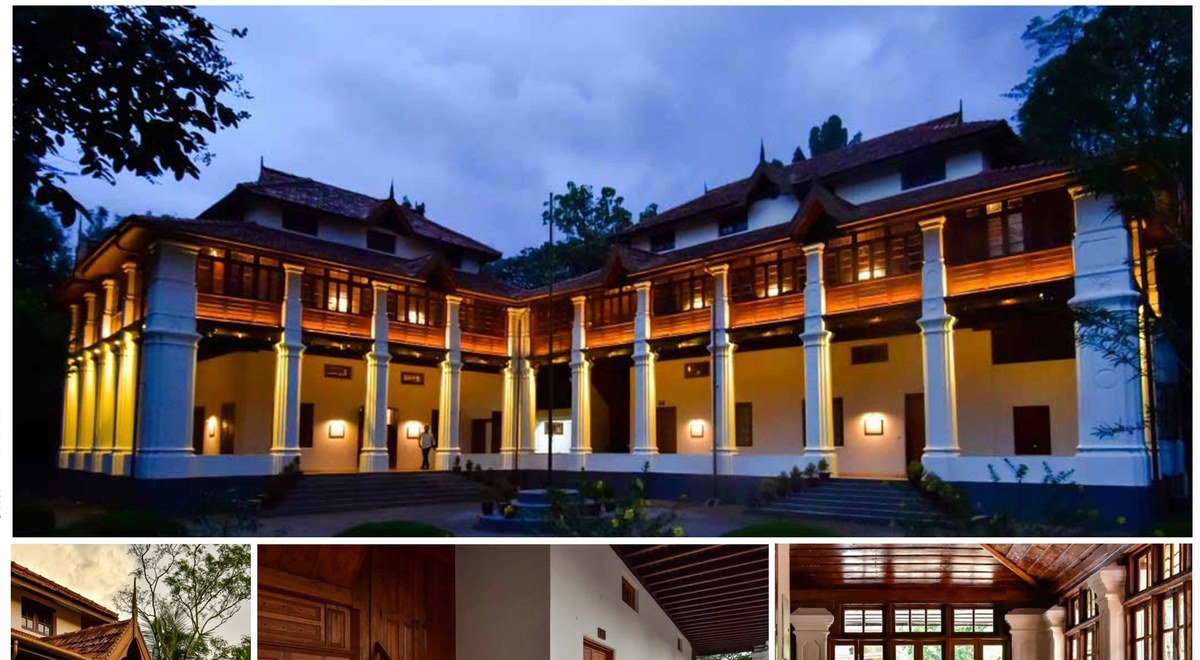
The Round Window
One detail I keep returning to: the circular window in the living room, positioned to frame a single tree outside. It is a small gesture, but it encapsulates the design's intent — the outside is not background, it is subject. The tree is not something to look past; it is the thing worth looking at.
In a climate as generous as Kerala's — where the landscape is lush, the light is warm, and the natural world is relentlessly present — the architect's job is often to step back and let the setting do its work. The building becomes a frame, and the frame should be worthy of what it contains.
The Broader Ethics
There is a wider argument here that I find myself returning to increasingly, especially in the context of rapid development in the Gulf and in urban India. We have become very good at building quickly and very poor at building carefully. Preservation — of trees, of ground conditions, of existing ecology — is not nostalgia. It is a technical discipline and an ethical commitment.
Every tree felled for a building is a calculation that the building was worth more than the tree. Sometimes that calculation is correct. But it should always be a conscious decision, made with full understanding of what is being lost — not a default, not an afterthought.
The House on the Hills is, in the end, a modest proposal: that a family home can be beautiful precisely because it chose not to clear the ground before it built.